

In a development being described as a watershed moment for India’s paramilitary establishment, senior IPS officer Sanjukta Parasor has assumed charge as Inspector General of the Central Reserve Police Force’s CoBRA unit, making her the first woman ever to lead the elite jungle-warfare formation in its history.
Parasor belongs to the 2006 batch of the Indian Police Service (IPS) of the Assam-Meghalaya cadre. She secured an All India Rank of 85 in that year’s civil services examination — a result strong enough to have opened the door to the administrative services — but she chose to set that aside in favour of policing, a decision that would eventually place her at the head of India’s most specialised counter-insurgency force. Long before this appointment, she had already carved out a distinct identity in the security establishment, earning the moniker “Iron Lady of Assam” for her hands-on approach to counter-insurgency operations in the Northeast.
Also read: Bollywood stars came out in their glamorous best to attend Ganesh Chaturthi celebrations
The appointment places Parasor in command of CoBRA — the Commando Battalion for Resolute Action — a force the Centre originally raised in 2008 with roughly 10,000 personnel under CRPF control, specifically to counter Maoist violence. Its commandos are trained for extended foot patrols over long distances, ambush and counter-ambush tactics, intelligence-driven missions, and operations in areas where improvised explosive devices remain a constant hazard. The force’s headquarters sits in the National Capital Region, with battalion-level headquarters positioned in nearly every state where Left-Wing Extremism has taken root, among them Chhattisgarh, Jharkhand, Andhra Pradesh and Maharashtra. She takes over from Danesh Rana, an officer of the 1996 batch, marking a generational as well as a symbolic shift in the force’s leadership.
Also read: Many porn videos found in phone that rape-convict ex-MP Prajwal Revanna was found using in jail
CoBRA’s commandos are trained for extended foot patrols over long distances, ambush and counter-ambush tactics, guerrilla warfare and survival skills, intelligence-driven missions, and operations in areas where improvised explosive devices remain a constant hazard.
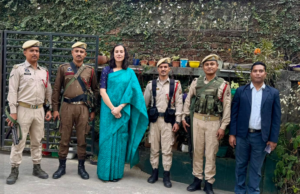
The Ministry of Home Affairs first cleared Parasor’s move to the CRPF on central deputation through an order dated 6 August 2026. The CRPF headquarters subsequently issued the specific posting order placing her at the head of CoBRA in the second week of September 2026, with her assumption of charge reported around September 8–12, formally closing the chapter on Rana’s tenure and opening a new one under her command.
While the appointment itself is headquartered in Delhi, its operational implications stretch across some of India’s most volatile geographies. CoBRA teams remain actively deployed across the Maoist-affected belt, and units have also been moved into Manipur in recent months, where the force has been tasked with containing recurring outbreaks of armed violence — a reminder that the unit’s mandate now extends well beyond its original anti-Naxal brief.
Parasor’s record reads almost like a checklist for the role. Her career began in 2008 as an Assistant Commandant, a posting that placed her in the middle of clashes between Bodo groups and settlers from across the Bangladesh border. She was later sent to Sonitpur as Superintendent of Police, where she led a sustained crackdown against the banned NDFB outfit — an operation that resulted in sixteen militants killed and sixty-four others arrested. A widely circulated photograph of her leading that operation, AK-47 in hand, is what first earned her the “Iron Lady of Assam” tag, though it also brought her direct threats to her life from Bodo militant groups, a risk she reportedly absorbed as part of the job rather than let alter her approach. She went on to serve with the National Investigation Agency as a Deputy Inspector General, handling cases tied to terrorism and extremist networks — work that placed her firmly within India’s national security apparatus rather than routine policing.
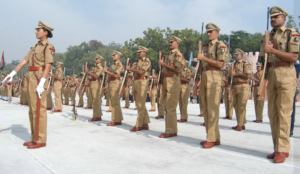
Her elevation also fits into a broader pattern within CRPF. The force’s Rapid Action Force is currently headed by Seema Dhundia, who was inducted in 1987 as part of the CRPF’s first-ever batch of women officers. Elsewhere, Vijaya Laxmi, also from the 2006 batch, was recently posted as IG of the sensitive Jammu sector; Nitu D. Bhattacharya heads the Madhya Pradesh sector and is credited with overseeing the effective end of Naxal activity in Balaghat; Kavita Jalan, from the Odisha cadre, commands the North-East sector covering Meghalaya and parts of Assam; and Archana Shivhare, a Gujarat-cadre officer, serves as IG in Rajasthan. A CRPF officer described this as a deliberate institutional push to place women in operationally demanding, combat-oriented commands rather than administrative roles alone — a trend of which Parasor’s CoBRA posting is now the most visible example.
Also read: Dera chief Gurmeet Ram Rahim, jailed for raping 2 women, released on furlough, his 17th in 9 years
What distinguishes Parasor’s trajectory, according to those who have worked alongside her, is that her reputation was not manufactured through publicity but built cumulatively through sustained exposure to difficult ground realities. Her academic background adds an unusual dimension to this profile: before entering the civil services, she studied political science at Indraprastha College, Delhi University, and went on to pursue International Relations at Jawaharlal Nehru University, eventually completing an MPhil and a doctorate focused on American foreign policy. That blend of scholarly grounding in strategic affairs and years of frontline operational command is, according to insiders, precisely why the CRPF believes she is equipped to steer CoBRA through a moment when the force’s mandate keeps expanding into new and unpredictable theatres of conflict.