


My relationship with Indian art is deeply personal, and yet somewhat distant. As a Canada-based artist and Indian art collector, I often find myself looking at the Indian art scene through a jalousie … close enough to feel connected, but also far enough away to observe it with a certain independence.
I am not fully entrenched in the ecosystem, and perhaps I like it this way. I can choose the artists, artworks, and stories that speak to me, without feeling the need to follow every movement or trend.
Growing up in Mumbai, I had Indian art as an integral part of my visual memory. I encountered the works of Indian masters in galleries, museums, and sometimes simply around the home. Their imagery, colours, mythology, and storytelling became part of how I understood my own cultural identity.
Also read: What’s age? Former soldier in Haryana acquires an MA degree at 85, keen on enrolling for PhD
For a long time, however, the Indian art world felt inaccessible to me. A lack of transparency around prices and provenance, combined with an unmistakable elite bias, meant that art often remained confined to niche circles. I remember feeling that there was a world of art that could be admired but not necessarily entered.
This is changing lately. A more affluent and curious Indian population, empowered by the internet, is engaging with art in ways that were once unimaginable. Online platforms have opened the doors, while auction houses such as SaffronArt, AstaGuru, and Pundole’s have brought greater visibility and transparency to pricing and market values.
Also read: Delhi horror: 17-year-old girl gangraped, stabbed to death; body eaten by stray dogs; 4 arrested
My own journey has been equally organic. I am a self-taught artist who found my language through trial, error, and persistence. Travelling to more than 75 countries exposed me to countless museums, galleries, artists, and cultures. Yet, despite these influences, I continually return to India. My work remains rooted in Indian mythology, not as nostalgia, but as a living language through which I continue to understand where I come from and, ultimately, who I am.
As a self-taught artist, I have arrived at my own artistic language through years of trial, error, curiosity, and perhaps a little stubbornness. I never had a formal vocabulary handed to me; I had to discover it myself. Along the way, the works of Indian masters have been some of my most important teachers.
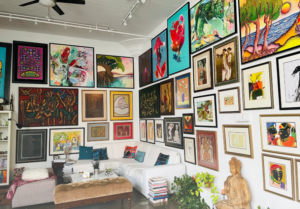
I have been drawn to the visceral distortions of FN Souza; the serene, floating forms of Manjit Bawa; and the effortless confidence of MF Husain’s compositions. From each, I have taken something … not to imitate, but to absorb. The Bengal School taught me something deeper: that a painting should capture not merely what you see, but what you feel as well.
Jamini Roy’s purposeful simplification of form and his transformation of Indian folk motifs showed me the power of restraint. Sunil Das confronted the viewer with the terror and inevitability of death, while Rabin Mondal revealed human hardship and depravity with an almost unsettling honesty.
A prominent Toronto based art collector and gallery owner once told me, “The more depressed or oppressed the masses, the more expressive and powerful the art.” Perhaps Bengal’s history helps explain this intensity. Famine, partition, communal violences, displacement, poverty and loss have left deep marks on its collective consciousness … and on the canvases of many of its artists.
Yet Bengal has also produced artists who remind us that beauty survives alongside suffering. The luminous works of Prokash Karmarkar, Lalu Prasad Shaw and Ganesh Haloi celebrate nature, light, space and life with a quiet poetry.
I feel fortunate to live surrounded by these works. After a long day, I sometimes sit quietly among them, looking at the paintings and imagining conversations with the artists who created them. They are no longer simply paintings on my walls; they have become companions, teachers, and windows into lives and experiences far removed from my own.
Also watch VIDEO: Chilling CCTV footage of Bengaluru law student Amrutha’s stabbing by her lover’s brother
There is something profoundly comforting about that. To me, this is the true privilege of collecting art: to never really be alone.
Send your comments on the article to editor@newsdare.com.
ABOUT THE AUTHOR

Based in Toronto, Vishal Misra leads a double creative life: a corporate finance professional working in accounting and internal audit, and a visual artist and illustrator. Born and raised in Mumbai, India, he moved to Canada to pursue his accounting career, yet he never let go of the artistic passion that he says has shaped his life.
