

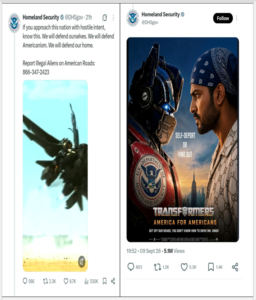
A digital advertisement circulated by the US Department of Homeland Security (DHS) — the federal agency responsible for immigration enforcement, border security, and related domestic security functions — has triggered accusations of racial profiling as it depicts an armoured robot confronting a turbaned, bearded man identified only as “Mr Singh.” Indian-American advocacy bodies have condemned the advertisement.
The graphic, styled after the Transformers film franchise, carries the line: “Get off our roads, you don’t know how to drive, Mr Singh.” The image was published on DHS’s official X account as part of a broader push urging undocumented migrants to leave the country on their own terms. A companion AI-generated clip went further, showing the franchise’s villain, Megatron, negotiating custody of individuals labelled “aliens” — the US administration’s chosen term for foreign nationals — including named truck drivers linked to road accidents and other offences.
Also read & WATCH: Delhi building collapse toll 7; HC says municipal corporation and Delhi University responsible for tragedy
The advertisement was issued by DHS under the Trump administration, and swiftly drew condemnation from Indian-American advocacy bodies, chiefly Hindu American Foundation (HAF) and Sikh Coalition. Both organisations argued that the surname “Singh” — common among Hindus and Sikhs alike, and widely represented in America’s trucking industry — was being used as shorthand to cast an entire community as reckless outsiders, regardless of immigration status. HAF went so far as to tag Assistant Attorney General Harmeet K Dhillon and FBI Director Kash Patel, pressing for federal scrutiny of the post.
The controversy is unfolding in real time, with the DHS poster and its accompanying video surfacing this week as part of the agency’s ongoing self-deportation messaging drive rather than a standalone release. Reporting on the incident began emerging within just the past few hours, indicating the advertisement’s circulation and the resulting furore are both extremely recent developments rather than a resurfaced or dated controversy. Reactions from the Hindu American Foundation and the Sikh Coalition followed almost immediately after the poster gained traction on X, with both organisations issuing public statements the same day the imagery began drawing wider attention.
This rapid-fire sequence — publication, viral spread, and organised pushback all compressed into a matter of hours — is itself notable, reflecting how quickly such content now travels on social media and how swiftly advocacy groups mobilised a coordinated response. The episode arrives against the backdrop of a broader, sustained DHS campaign around voluntary departures that has been running for some time, meaning the poster is best understood not as an isolated flashpoint but as the latest flare-up in a messaging effort that has already drawn scrutiny on previous occasions.
As of this writing, the story remains active, with DHS yet to respond formally to the criticism, leaving open the possibility of further developments — whether an official clarification, a retraction, or escalation into congressional or civil-rights inquiries — in the days ahead. Given the pace at which the reaction has built, updates to this timeline are likely imminent. The controversy rooted in the United States, playing out primarily on X, where DHS maintains an active presence promoting its immigration enforcement agenda. The fallout, however, has reached far beyond the platform, resonating within diaspora communities and advocacy circles who see the imagery as emblematic of a pattern rather than an isolated lapse.
DHS has framed the campaign as an extension of its “Self-deport or find out” messaging, tied to the CBP Home programme that offers undocumented migrants travel support and a $2,600 exit incentive to leave voluntarily. Officials cast the effort as a defence of national sovereignty, with the agency declaring on X that it would “defend Americanism” against those it deemed hostile.
Critics counter that the campaign’s satirical packaging masks a cruder intent — conflating a handful of individuals implicated in wrongdoing with an entire ethnic and religious identity, thereby normalising suspicion toward lawful citizens and residents who happen to share a common surname.
The messaging leaned on pop-culture familiarity to soften a pointed jab, borrowing Optimus Prime — reimagined with a DHS patch — as a stand-in for American authority confronting the caricatured “Mr Singh.” A notable irony threads through the concept itself: the robot invoked to represent the nation’s interests is, within Transformers lore, an alien being, a detail advocacy groups and commentators have flagged as an unintended contradiction.
Sikh Coalition situated the episode within a longer history of profiling, noting that, a quarter-century after the September 11 attacks, turbaned and bearded men continue to face suspicion rooted in appearance rather than conduct. The organisation added that Sikhs — whose surname translates to “lion” — remain unwilling to hide their identity even as official channels appear to frame them as adversaries.
Also read: 8 Tamil Nadu engineering students killed as their car rams a parked lorry on Kerala’s NH-66
As of now, DHS has not withdrawn the advertisement or issued a clarification addressing the specific grievances raised. The episode adds to a string of controversies surrounding the administration’s immigration messaging strategy, raising fresh questions about where satire ends and targeted stereotyping begins — and whether federal communications ought to carry that risk at all.