


Even as Nepal struggles to rescue people trapped in flooded areas along the Tibetan border after the massive deluge, in which 734 people have lost their lives and over 2,500 remain missing so far, heart-balming stories of people getting saved from near-death situations during the flood are coming out.
A group of 28 pilgrims from southern India who returned safe to their homes on Saturday, August 29, after spending two anxious days in Nepal have narrated their providential escape from death. Members of the group, which was undertaking the Kailash Mansarovar Yatra, said how it was a brief tea break and a 10-minute delay that saved their lives, as per The Times of India.
Also read: As everyone searches for happiness, Aditya Chopra’s book shows how to acquire it step by step
The group, which had people from Karnataka, Tamil Nadu, and Andhra Pradesh, is particularly happy that they did not make it to the Syabrubesi bridge because, if they had, they would have lost their lives as the bridge was washed away in the floods.
“We were supposed to reach Syabrubesi, along the Nepal-Tibet border, early. But a tea break and a 10-minute delay saved the lives of all 28 of us. Our driver responded swiftly to the calamity, took a detour and moved us to safety,” said Pemmasani Venkataramana, the managing director of Tirupati-based ‘Sign In Travels’, who was was part of the 28-member group.
Krishnaiah Muthyala of Visakhapatnam, another pilgrim in the group, said, “Our group was scheduled to visit Mansarovar. The three-day delay in getting our visas also delayed our overall journey. Otherwise, we would have been on the Syabrubesi bridge when it was washed away in the floods. All of us could have lost our lives”.
The Tirupati group’s narrow escape is one of several such accounts emerging from Indian pilgrim parties in the flood’s aftermath, as families and travel operators piece together how close-run some of these journeys were.
Syabrubesi got buried in mud
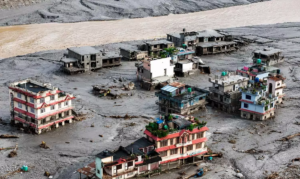
The flood originated high in the Lhende Khola, a tributary that feeds into the Bhote Koshi River near the Rasuwagadhi border crossing, before tearing south through Timure and Syabrubesi — the main trailhead town for the Langtang trekking region — and on down toward Trishuli Bazar, a stretch of roughly 60 kilometres.
Also read: Tied up and set ablaze, Chandigarh influencer Manjeet Kaur dies after 54 days of suffering
Satellite imagery released by Planet Labs showed roads and buildings scoured away at Timure and Rasuwagadhi, with Syabrubesi left buried in mud. Because the Rasuwagadhi-Kyirong crossing is the main overland route used for the Kailash Mansarovar Yatra, and late August falls in peak pilgrimage season, a large share of those missing are believed to be pilgrims and trekkers who were passing through the valley when the disaster hit.
Death toll touches 734
The death toll from the devastating floods in Nepal along the Tibetan border has surged to 734, with more than 2,500 still missing, according to the Nepal government. The flood was triggered by a glacial collapse in the Himalayas, leading to the formation of lakes along the valley that tore through several villages along the Nepal-Tibet border.
Also WATCH: Frightening visuals from Nepal’s devastating floods: Read the story and watch the videos
The flooding damaged thousands of houses and settlements along the border, causing widespread destruction in the region. Key hydro projects and solar plants along the Trishuli River in Nuwakot district suffered extensive damage.
India sends help
An 11-member team from India landed in Kathmandu on Saturday, August 29, to assist the ongoing search-and-rescue missions.
On Sunday, August 30, New Delhi dispatched a fourth relief flight to Kathmandu carrying essential humanitarian supplies. Announcing the development on X, External Affairs Minister S Jaishankar said the aircraft had successfully landed in the Nepalese capital with essential supplies.
“The fourth Indian flight has touched down in Kathmandu. It brings essential supplies and technical capabilities to support Nepal’s ongoing rescue & relief operations”, Jaishankar wrote.