




Walk through the lanes of Mayapur or Vrindavan at dawn, or step into a downtown yoga studio in New York on a weekday evening, and you are likely to hear these same sixteen words: Hare Krishna Hare Krishna, Krishna Krishna Hare Hare Hare Rama Hare Rama, Rama Rama Hare Hare. Across continents and centuries, this string of syllables — known as the Hare Krishna Mahamantra — continues to draw people who are searching for calm, meaning, or simply a break from the noise in their own heads. News Dare looks at why this particular chant has endured, what practitioners and teachers say it actually does, and how it is meant to be practiced.
What is the mahamantra?
The mahamantra is built from three names — Hare, Krishna, and Rama — arranged in a fixed, repeating sequence. Within the Gaudiya Vaishnava tradition that popularized it, “Hare” invokes the divine feminine principle of devotion, while “Krishna” and “Rama” address the Supreme in two of his most beloved forms. Put together, the mantra functions less like a request and more like an invitation: a call for the chanter to be drawn into a state of loving remembrance rather than material want.
Also read: 34 stabs in 40 seconds: Faridabad woman teacher’s murder on school premises raises many questions
A core belief underlying the practice is that the name and the one being named are not separate things. In this view, the sound itself is treated as a living, spiritual presence — not a symbol pointing to something distant, but a direct carrier of it. That belief is part of why chanting is treated as more than a ritual formality in this tradition; it is treated as an encounter. After the devastating floods in Nepal caused by glacial collapse, two hydroppwer workers spent nine days buried underground before they could be pulled out to safaty. Chanting the mahamantra helped them survive through those nine painful days, they said.
What is the importance of chanting mantras?
It’s a question worth asking plainly: does repeating a sound really change anything? Teachers within this tradition, and across several other schools of Indian spiritual practice, tend to answer with an analogy drawn from ordinary life.
Consider what happens when someone insults you. If a person calls you a fool, or worse, notice what follows. A knot forms in the stomach. The head feels tight. Anger rises, seemingly on its own. A single unkind word is enough to trigger a measurable physical and emotional reaction — tension, heat, a racing pulse. If mere words of insult can do that much to the body, the argument goes, it is not reasonable to assume that a name chanted with reverence, carrying none of that hostility, does nothing at all. Teachers describe this dismissal of mantra as unscientific rather than rational — the position that sound has no effect on the body simply doesn’t hold up against everyday experience of how words already affect us.
This is part of why the practice is sometimes described using the image of a “mantra kavach,” or mantra armour: repeated chanting is said to build a kind of protective field around a person, altering the atmosphere they carry with them.
Anyone who has walked into a room and immediately wanted to talk to a stranger — or, just as quickly, wanted to walk away from someone else — has already experienced something like this effect. People seem to give off a kind of charge, pleasant or unpleasant, often without saying a word. According to those who teach mantra practice, sustained chanting is meant to shift that inner charge from repulsion toward warmth, gradually changing not just the practitioner’s mood but how others experience being near them.
The practice is far from confined to India today. In New York City alone, chanting circles and evening classes have multiplied in recent years, with participants gathering for an hour after work to chant “Om Namah Shivaya,” “Om Namo Narayana,” or “Sri Rama Jai Ram Jai Jai Ram” — the words shifting slightly in accent from group to group. In China, some practitioners chant “Ladhe Ladhe” in place of “Radhe Radhe,” and in Taiwan, gatherings of several thousand people have been reported chanting “Ladhe Govind” instead of “Radhe Govind” — regional pronunciation changing the sound but, teachers say, not the underlying effect. Those who lead these sessions insist the results are consistently reported by participants, regardless of geography or accent.
Timing matters too, according to this teaching. Chanting done after pranayama (breath control) and a period of meditation is said to land more deeply, because the mind and body are already settled. Chanting attempted at a surface level — distracted, rushed, or disconnected from any inner quiet — is considered far less effective, even if the same words are technically being said.
Traditional benefits ascribed to chanting
Scriptural literature within the Vaishnava tradition, along with the teachings of the 16th-century Bengali saint Sri Chaitanya Mahaprabhu — who is credited with popularizing congregational chanting, or sankirtana, across Bengal — lists a wide array of benefits said to follow from sincere practice.
Also read: Cops can’t lathicharge people protesting peacefully, says Supreme Court; may fix police guidelines
A complete spiritual path for the present age is how Puranic texts describe chanting the Holy Name, framing it as the primary route to liberation in the current age and said to be more effective than disciplines that suited earlier eras.
Release from past wrongdoing is another benefit commonly cited, with stories such as that of the deathbed sinner Ajamila offered to show that even an involuntary utterance of a sacred name, spoken in desperation, is believed to erase the weight of misdeeds accumulated over many lifetimes.
Also read: Noida boy’s death by falling into pit shows human life remains cheap in India as civic apathy reigns
A practice said to outweigh formal ritual, chanting is held by these texts to carry more spiritual weight in a single sincere utterance than elaborate vows or rites, because the name itself is understood to hold the qualities of the divine being it addresses.
A buffer against fear is described in several passages, where chanters are said to become less anxious in the face of illness or misfortune, since steady remembrance of the divine is believed to calm the nervous reactions that ordinarily accompany hardship.
Also read: 29 years ago, Dharmendra Pradhan protested against a paper leak in Odisha, got beaten up by police
Relief from mental burden is often illustrated through the image of wind clearing storm clouds or sunrise dissolving darkness — a comparison meant to convey how accumulated stress and disturbance are said to lift with sustained practice.
Personal transformation is perhaps the most striking claim of all: tradition holds that consistent, heartfelt chanting can turn even a deeply flawed person toward genuine virtue, to the point where their presence begins to have a similarly settling effect on others.
Also read: First & only goal in 106th minute! How FIFA World Cup ’26 final was a tense fight between titans.
A discipline ranked above others is how various texts position chanting relative to formal scriptural study, pilgrimage, and structured yogic practice — not because those paths lack value, but because they are seen as ultimately pointing toward the same devotion that chanting cultivates directly.
How the mahamantra is chanted
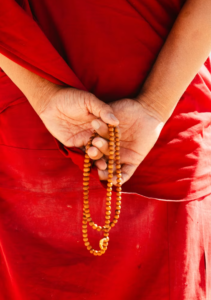
Most practitioners chant using a string of 108 japa beads, reciting the full mantra once per bead and completing one “round” per full circuit. A commonly cited target for serious practitioners is sixteen rounds a day, though newcomers are generally encouraged to start small and build gradually rather than feel discouraged by the number.
Many begin their practice with a short invocation to Sri Chaitanya Mahaprabhu and his close associates, asking for guidance to chant without error or ego. Chanting can be silent, murmured, or done aloud in a group — group chanting, or kirtan, holds a special place in this tradition for the way it draws a room of strangers into something communal.
Also read: NEET UG 2026 topper Aryan Gupta’s inspiring journey: discipline, purpose and a dream to fight cancer
Sincerity, teachers repeatedly stress, is not optional. The practice is described as one that reveals more of itself the more genuinely it is approached — not a mechanical repetition, but something closer to a relationship that deepens with attention over time.
The takeaway
Whether viewed through the lens of centuries-old Vaishnava theology or through the more contemporary language of stress relief and nervous-system regulation, the Hare Krishna Mahamantra keeps finding new audiences. Its practitioners, old and new, describe it the same way: not as one technique among many, but as a doorway — one that opens a little further each time someone chooses to walk through it.
This article is for informational purposes and does not constitute medical, psychological, or professional advice. Readers dealing with a health or mental health concern should consult a qualified professional. The opinions contained in this are the author’s own.
Send your comments on this article to editor@newsdare.com.
