



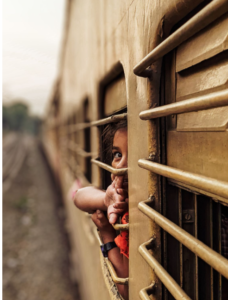
 Love does not always arrive with grand gestures. Sometimes it enters quietly, between crowded train compartments, shared glances, and five railway stations that slowly begin to feel like home.
Every morning, the 8:10 local train carried hundreds of tired office-goers through the restless city. Among them was Mahesh, a young banker known for his neatly ironed shirts, polite smile, and habit of reading financial newspapers during travel.
And then there was Rani. Rani worked at a cosmetic retail store owned by her uncle in a busy market area. Elegant, soft-spoken, and graceful, she had learned very early in life how to survive judgment without letting it harden her heart.
Rani had been blessed with delicate features and a naturally feminine appearance. Most people who met her never guessed she was transgender. Yet beauty did not protect her from the quiet fears she carried within. Being a transgender woman in a society that often refused to understand others meant living with invisible wounds every single day. People rarely stared openly at her, but sometimes she still felt whispers floating behind her back, leaving traces of doubt in her mind. Over the years, Rani had learned to build her life carefully and quietly, holding on to her dignity with remarkable strength.
The local train became her little escape from the world.
The first time she noticed Mahesh, he was standing near the train door, struggling to balance himself while replying to office calls. The compartment was overcrowded, and without thinking much, Rani shifted slightly and said softly, “You can sit here.” That became the beginning.
Also read: Rath Yatra in Puri: Odisha govt steps up safety efforts to avert mishaps
The next morning she saved the same spot for him. And the next. Soon, Mahesh began entering the compartment with an unconscious smile, already searching for her face in the crowd.
For five stations every day, they talked. About office stress. About irritating bosses. About rising train fares. About favourite foods and old Hindi songs. Nothing dramatic. Yet everything meaningful.
Slowly, Rani began carrying an extra tiffin box. The first time she handed it to him, Mahesh laughed awkwardly. “You’ll spoil me like this,” he said. But he finished every bite. Some days it was lemon rice. Some days aloo paratha. Sometimes simple poha with peanuts. Mahesh would return the empty box carefully washed, as though it were something precious.
Then one evening, when Rani opened the tiffin after returning home, she found a small chocolate inside. And a folded handwritten note. “Food tastes better when someone cares.” Rani read the line again and again. For the first time in years, her hands trembled not out of fear, but hope.
Also read: The Quiet Cost of Being Useful
After that, their silence also became comfortable. Some mornings they simply sat beside each other watching the city pass by through the train windows. No words. Just presence. And strangely, that became love.
Mahesh never asked questions about her past. Never looked at her with suspicion. Never made her feel different. To him, Rani was simply Rani. And that terrified her. Because Rani knew something Mahesh did not.
One evening, after nearly four months of travelling together, Mahesh looked unusually disturbed. “My transfer has come,” he said quietly. “I’ll probably leave next month.” Rani felt her throat tighten. Then he added softly, “My parents are also forcing me to get married before I leave.” That night, Rani did not sleep.
The thought of losing him felt unbearable. Yet the thought of telling him the truth frightened her even more. The next morning Mahesh smiled weakly and confessed, “I couldn’t sleep either.”
Also read: True Love Stories: Again after twenty years
Over the next few days, the conversations grew heavier, slower, filled with unfinished sentences.Then one morning, just before his station arrived, Mahesh suddenly asked, “What’s your caste?” Rani looked confused. He continued nervously, “I want to meet your parents. If they agree… I want to marry you before I leave.” For a moment, the sounds of the train disappeared.
Rani stared at him in complete shock. No one had ever loved her like this. Not beyond curiosity. Not beyond attraction. Certainly not enough to speak of marriage. That evening, she finally gathered the courage to tell him.
Standing near the crowded railway bridge, with trembling hands and tear-filled eyes, she whispered, “Mahesh… I was not born the way you think. I am transgender. I cannot give you children. You deserve a normal life.” The words shattered her as she spoke them. She expected anger. Disgust. Shock.
Instead, Mahesh stood silent for a long time. Then very gently, he asked, “All these months… was your care fake?” Rani shook her head immediately, crying now. “Was your love fake?” he asked again. “No,” she whispered. Mahesh smiled through moist eyes. “Then why are you deciding what my happiness should look like?” Rani broke down completely.
For the first time in her life, someone was not reducing her to her identity. Someone was seeing her heart first. The journey ahead was not easy.
Mahesh’s family resisted fiercely. His mother stopped speaking to him for weeks. Relatives mocked him. Friends warned him he was making a mistake. But Mahesh did not walk away. And Rani, despite her fear, stopped apologizing for existing.
A year later, they quietly registered their marriage in the presence of a few close friends and Rani’s uncle, who cried throughout the ceremony.
Today, they live in a small apartment in another city where Mahesh was transferred. Every morning before work, Rani still packs him a tiffin box. And sometimes, when she opens the empty box at night, she still finds a chocolate inside. Along with little handwritten notes.
Because real love is not always about grand acceptance from the world. Sometimes, it is simply about two people choosing each other, every single day, despite the world.