



Four days after a glacial collapse near the Nepal-Tibet border unleashed a wall of ice, rock and mud through central Nepal, the death toll continued climbing on Saturday, August 29, with authorities in Kathmandu and Beijing still struggling to establish a full picture of the disaster.
Nepal’s police put the national death toll at 676, with nearly 2,500 people still unaccounted for, while China’s state media confirmed seven fatalities and more than 550 missing on the Tibetan side of the border — pushing the combined tally of the missing across both countries toward 3,000, according to figures cited by wire agencies including the Associated Press and Reuters. Search teams have recovered bodies in all eight of Nepal’s affected districts, and officials say the operation is being run “on a war footing.”
Among the missing are dozens of Americans, at least 41 Australians and other foreign nationals — including trekkers, pilgrims and tour groups who were in the region when the disaster struck. Nearly 3,000 stranded people, including more than 160 foreigners, have so far been pulled to safety by rescue teams.
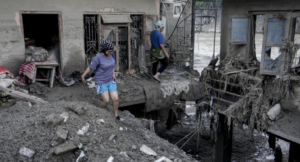
Investigators believe the catastrophe began when a large section of a Himalayan glacier broke away and crashed into the Lhende Khola river near the Nepal-Tibet frontier, sending a torrent of ice, water and debris slamming into towns and villages downstream on Wednesday, August 26. The flood tore out bridges, roads and hydropower infrastructure across central Nepal, cutting off entire communities and complicating the rescue effort that followed.
Damaged roads, patchy communications and forecasts of intermittent rain through the weekend have all slowed the search, officials say. One of the most urgent fronts is a mud-choked hydropower tunnel where close to 100 Nepali workers are believed trapped — a rescue Kathmandu has asked Beijing to help with directly. Nepal’s Foreign Minister, Shishir Khanal, said the government had specifically sought outside help in areas “where we don’t have enough expertise and technical know-how,” rather than a broader international deployment. China has since flown a team of specialists into the area from Tibet.
Authorities are also watching a second, newly formed glacial lake near the disaster zone amid concern it could trigger further flooding if it breaches.
Also read: If India could speak to herself: A letter from 1947 to the India of 2026
India’s response
Speaking to reporters in Lucknow, India’s defence minister Rajnath Singh said New Delhi shared Kathmandu’s alarm over the scale of the disaster and confirmed relief material was already moving across the border. He said Prime Minister Narendra Modi had assured Nepal that India stood ready to provide “whatever assistance is required.” India has also stepped up monitoring of its own Himalayan frontier with Nepal and China in the disaster’s aftermath.
Also read: Cow priority: Doctor assaulted after his car hits stray cow in UP’s Badaun; 4 people arrested
