


Telugu actress Faria Abdullah found herself at the centre of an unexpected storm this month — not for a film role, but for a festival. On Monday, August 10, she was spotted joining Hyderabad’s vibrant Bonalu celebrations at the Sri Mahankaleshwara Ammavari Temple in Miralam Mandi near the iconic Char Minar in Hyderabad, dressed in traditional attire and carrying a bonam like the devotees around her. What should have been a simple moment of shared cultural joy instead ignited a wave of online hostility over her being a Muslim and taking part in a Hindu festival — and what followed revealed far more about the actor’s character than any scripted role ever could.
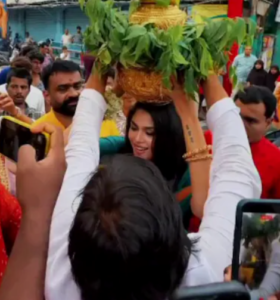
Clips of her immersed in the festivities spread quickly across social media, and with them came a chorus of criticism from a section of users who couldn’t reconcile her presence at a Hindu festival with her Muslim identity. The comments grew personal and cruel, with some accusing her of betraying her faith outright and hurling the label “kafir” — disbeliever — at her, as though devotion and cultural belonging were mutually exclusive.
Also WATCH: Frightening visuals from Nepal’s devastating floods: Read the story and watch the videos
Rather than retreat or issue a curt clarification, Faria chose to meet the moment head-on. In a raw, unfiltered video posted to social media, she let her guard down completely, visibly emotional as she addressed the wave of judgment head-on. She spoke of her father, who had embraced Islam out of genuine admiration for the faith, and of the values he had passed down to her — an upbringing steeped in the religion’s teachings on goodness and compassion.
“I have always seen the good about Islam,” she said, before turning her attention directly to those attacking her. Rather than firing back, she offered something far more disarming: goodwill. Whoever doubted her path, whoever branded her a “kafir,” she said, she wished them well all the same.
WATCH FARIA ABDULLAH’S EXPLANATION HERE:
It was in the video’s most striking passage that Faria articulated the philosophy steering her through the controversy — that faith, for her, isn’t confined by ritual or geography, but revealed in the sheer wonder of existence itself. With tears tracing down her face, she spoke of glimpsing the divine in the smallest, most ordinary corners of life: in trees, in rocks, in the flutter of a butterfly’s wings. To her, that sense of awe wasn’t a distraction from belief — it was belief, in its purest, most unguarded form. Anyone who couldn’t find that same magic in the world around them, she suggested gently, was missing something essential.
Also read: Who is Deepak Mhaske, the quiet Chhattisgarh ex-professor who is now BJP’s new IT Cell chief?
What could easily have spiraled into a bitter public feud instead became a masterclass in restraint. Faria was unambiguous that she had no interest in confrontation with those who saw things differently. Instead of trading insults or demanding apologies, she extended empathy to the very people who had tried to hurt her — a choice that has since resonated with many online, turning a moment of vitriol into one of quiet dignity.
Also read: Cow priority: Doctor assaulted after his car hits stray cow in UP’s Badaun; 4 people arrested
In an era where online outrage often escalates faster than it can be reasoned with, Faria Abdullah’s response stood apart: not defensive, not vengeful, but disarmingly human — proof that grace can be the loudest reply of all.