



In a publishing landscape crowded with “think positive” manuals and gratitude journals, Aditya Chopra takes a harder, less glamorous route in his book ‘Happiness Is a Skill’. There is something deeply refreshing about this book because it refuses to romanticise happiness. Chopra insists that happiness is not a mood to chase but a skill to practise. That premise alone makes the book worth reading and recommending to one’s loved circle.
Every chapter in the book ends with reflection worksheets—simple prompts that ask readers to pause, reframe, and choose one small action. These exercises are accessible, but they risk feeling too prescriptive. Not every reader will want to reduce their inner life to a checklist. The illustrations, though minimal, do add texture: scribbled thought bubbles, paperclip notes, and the visual metaphor of cluttered minds make the ideas more relatable. Yet at times, the design feels like it is compensating for prose that could have gone deeper.
Also read: Cow priority: Doctor assaulted after his car hits stray cow in UP’s Badaun; 4 people arrested
Chopra’s most compelling idea is the “Load–Capacity Gap.” He argues that unhappiness often begins not with a lack of meaning but with sustained overload—fragmented attention, constant stimulation, and the body stuck in compensation. His framework of Green, Amber, and Red body states is clear and memorable: Green when capacity exceeds load, Amber when recovery slows, Red when overload makes happiness inaccessible. It’s a neat diagnostic tool, but also reductive. Human experience rarely fits into traffic‑light categories, and the risk here is oversimplification. Still, the metaphor works well enough to provoke reflection.
The narrative sections—where Chopra recounts conversations with professionals, students, homemakers—are some of the strongest. People who are “functioning well” but quietly tense, fatigued, or unsettled give the book its authenticity. These vignettes remind us that exhaustion is not always crisis, but accumulation. Yet the book sometimes slips into generalisation. The voices of those hundreds of participants are filtered through Chopra’s lens, and one wishes for more direct testimony, less interpretation.
Also read: Death of woman, 32, due to bad roads in Bengaluru causes grief and fury in India’s Silicon Valley
Chapter transitions are pinned with synopses that shift the focus: from mindset to capacity, from weight to proportion, from effort to accuracy. These summaries are effective, but they also highlight a limitation—the book often tells us what happiness is not, without fully showing us what it is. For example, the chapter “What Never Settles” gestures at mental clutter and unresolved weight, but the solutions remain vague. The insistence that happiness cannot be practised in a body that is constantly compensating is true, but it leaves the reader asking: what then? Beyond slowing down or saying no, the practical roadmap feels thin.
Where Chopra succeeds is in reframing ambition. He does not ask us to abandon responsibility or retreat from modern life. Instead, he argues for proportion: effort landing where it matters, rest that restores, energy spent with accuracy rather than brute force. This is a valuable counterpoint to the culture of hustle. His corporate background lends credibility—he knows the cost of perpetual achievement—but it also colours the book. At times, the advice feels tailored to professionals and leaders, less so to those whose exhaustion comes from caregiving, poverty, or systemic pressures. Happiness as a skill may not be equally accessible to all.
The illustrations—scribbles of confusion, paper‑clipped notes, the traffic‑light metaphor—make the book visually engaging. They remind us that happiness is messy, not polished. Yet they also risk trivialising complex ideas. A reader looking for depth may find the visuals charming but insufficient.
Critically, the book’s greatest strength is also its weakness. By insisting that happiness is a skill, Chopra empowers readers to practise it daily. But in doing so, he risks underplaying structural realities—workplace exploitation, social inequality, cultural expectations—that no amount of personal skill can fully offset. The danger is that readers may blame themselves for failing to “practise happiness” in environments that are fundamentally unsustainable.
Also read: I know you love handloom sarees, but handloom has to be a way of life beyond sarees
And yet, the book remains timely. It speaks to a generation that knows how to achieve but is learning that achievement alone cannot sustain a fulfilling life. It reminds us that a successful life and a sustainable life are not always the same thing. The takeaway is clear: we don’t necessarily need to create more happiness; we may first need to create more space for it.
Space to breathe. Space to rest. Space to say no. Space to be unavailable.
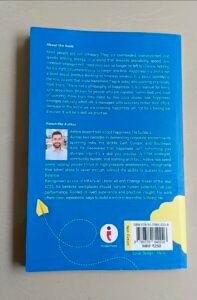
In the end, Happiness Is a Skill is not flawless. It simplifies, it generalises, it sometimes skirts the harder questions. But it is also honest, practical, and deeply relevant. It does not promise transformation. It offers proportion. In a world addicted to overload, that is no small gift. https://amzn.in/d/0alxwtM4
Send your comments on this article to editor@newsdare.com.
