



Jakarta witnessed a rare confluence of heritage, artistry, and diplomacy when textile designer Papri Basak from Shantiniketan, West Bengal, presented her latest collection, Meghmala, at the Opening Ceremony of Indonesia Fashion Week 2026. The event, held at Jakarta International Convention Centre in the last week of July, was not merely a fashion showcase but a cultural dialogue—part of the broader Tagore–Dewantara Year of Cultural and Educational Diplomacy—commemorating the shared civilisational ties between India and Indonesia.
Basak’s participation stood out as one of the most evocative moments of the festival, bringing the ethos of Shantiniketan into conversation with Indonesian traditions of batik and textile artistry. Her collection, inspired by the rhythm and beauty of the monsoon, became a poetic bridge between two nations bound by craft, culture, and history.
Also read: Mamata Banerjee says stones, shoes, mud thrown at her car in presence of Bengal police team
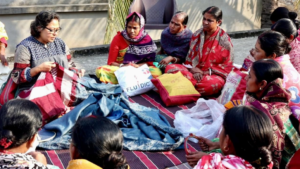
Papri Basak’s journey is deeply rooted in the artistic soil of Shantiniketan, where she studied at Kala Bhavana, Visva-Bharati University. The environment envisioned by Rabindranath Tagore—where art, nature, and everyday life exist in seamless dialogue—profoundly shaped her creative outlook. Over two decades, Basak has worked across India and Bangladesh, mastering techniques such as handloom weaving, natural dyeing, block printing, batik, resist dyeing, and hand embroidery.
WATCH VIDEO:
Her career includes significant stints with Aarong, Bangladesh’s leading fashion and lifestyle brand, and collaborations with artisans and craft clusters across the subcontinent. Today, through her Santiniketan-based practice, she continues to explore the dialogue between tradition and innovation, sustainability and modernity, heritage and global design conversations.
Meghmala: A Monsoon in Textiles
The Jakarta runway became a canvas for Basak’s latest collection, Meghmala. The name itself—meaning “cloud garland”—evokes the imagery of rain-filled skies and the emotional landscape of the monsoon. For Basak, the monsoon is not only a season but a philosophy: a time of renewal, balance, and quiet reflection.
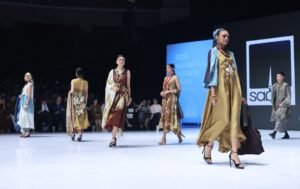
Her textiles drew directly from the monsoon palette: cloud greys, moss greens, indigo blues, earthy browns, ochres, and delicate pastels, punctuated by flashes of red-orange reminiscent of gathering storms. The garments were crafted from eco-friendly Indian handloom textiles—cotton, silk, and linen—chosen for their breathability and natural elegance in tropical climates.

Traditional techniques formed the foundation: hand batik, hand-block printing, shibori resist dyeing, natural indigo dyeing, and kantha embroidery from Bengal. Yet the silhouettes were contemporary—fluid drapes, clean lines, and understated tailoring that spoke to a global audience. The result was a collection that felt timeless and effortless, carrying the touch of the artisan while embracing modern aesthetics.
Also read: Cow priority: Doctor assaulted after his car hits stray cow in UP’s Badaun; 4 people arrested
The significance of Basak’s show extended beyond fashion. The Tagore–Dewantara Year of Cultural and Educational Diplomacy (July 2026 – September 2027) was inaugurated to celebrate the centenary of Rabindranath Tagore’s visit to Indonesia and his intellectual kinship with Ki Hadjar Dewantara, the pioneering Indonesian educator. Both figures believed in freedom through art and learning, and their legacies continue to inspire cultural exchange.
The festival included films, literature, textiles, education, and scholarship exchanges. Basak’s Meghmala was positioned as a highlight within this framework, symbolizing the enduring influence of Indonesian batik on Indian textile traditions and the reciprocal inspiration that continues to flow between the two nations.
Her presentation was not only a fashion show but a diplomatic gesture, an artistic offering that embodied the spirit of dialogue, respect, and shared heritage.
As the lights dimmed and the first models stepped onto the runway, the audience was transported into a monsoon dreamscape. The garments moved with fluid grace, echoing the gentle sway of leaves in the wind and the shimmer of rain on water. The textures—hand-dyed indigos, resist patterns, embroidered surfaces—carried the memory of the handmade, each piece bearing the touch of artisans from Bengal.
The audience, comprising diplomats, designers, scholars, and fashion enthusiasts, responded with admiration. Many noted how Basak’s work resonated with Indonesian traditions while retaining its distinct Indian identity. The dialogue between batik and block print, shibori and ikat, kantha and local embroidery became visible on stage, underscoring the shared vocabulary of craft across Asia.
Critics praised the collection for its sustainability, craftsmanship, and cultural depth, calling it “a monsoon woven into fabric” and “a meditation on heritage in contemporary form.”
Diplomacy through design was the essence of Basak’s show, which exemplified how fashion can transcend aesthetics to become a medium of cultural dialogue and exchange. By presenting Meghmala in Jakarta, she not only showcased Indian handloom heritage but also acknowledged the cultural exchanges that have historically shaped it. The influence of Indonesian batik on Indian craft traditions was openly celebrated, while the collection itself became a gesture of reciprocity—an offering from Shantiniketan to Jakarta.
This aligns with the broader goals of the Tagore–Dewantara initiative: to strengthen cultural and educational ties, foster people-to-people contact, and celebrate shared civilizational values. In this context, Basak’s work was more than a fashion statement; it was a cultural bridge.
“A personal reflection on history, craft, and legacy was central to my Jakarta experience: In 1927, Rabindranath Thakur visited Java and was deeply inspired by the art of Batik. Today, Santiniketan Batik has carved its own identity across the world, carrying forward Gurudev’s vision of craft as culture. On the 100th anniversary of his Java journey, I feel truly honored to have been invited by the Embassy of India in Indonesia to showcase my Batik collection Meghmala at Indonesia Fashion Week. For me, this was more than a fashion show—it was history, craft, and legacy coming together on one stage. My heartfelt gratitude goes to Dr. Taruna Chakraborty and His Excellency Sandeep Chakraborty, Ambassador of India to Indonesia, for believing in me and giving me this incredible opportunity. I would also like to extend my sincere thanks to the entire team of the Indian Embassy for their support and warmth throughout this journey,” said Basak.
Also read: Who is Deepak Mhaske, the quiet Chhattisgarh ex-professor who is now BJP’s new IT Cell chief?
The soul of Meghmala was brought alive through music. With ideation and direction by Mrinalini Guha Thakurta (Mrinalini Mukherjee) and arrangement by Surajit Das, the soundscape became an inseparable part of the collection, echoing the rhythm of the monsoon.
“My deepest thanks to them for creating the heartbeat of this work. I am equally grateful to Ananya Banerjee and Shumon Sengupta for their constant encouragement and support, which sustained me through this creative journey,” said Basak.
This reflection by Basak added depth to the Jakarta showcase, reminding the audience that fashion is not only about garments but about memory, gratitude, and continuity.
Also read: Smriti Irani, Ram Madhav back in BJP’s new national team; Amit Malviya out as IT Cell chief
A career of craft and commitment found its latest milestone in Basak’s Jakarta presentation, a showcase that reflected her dedication to both artistry and community. From her early work with Hingula Tassar and Silk in Orissa to her leadership roles at Kumudini Handicrafts and Aarong in Bangladesh, she has consistently engaged with artisans and clusters, bringing traditional knowledge into contemporary design.
Her teaching stints at Shanto Mariam University of Creative Technology and INIFD in Dhaka, along with workshops in Santiniketan, Ajmer, and Australia, reflect her commitment to education and knowledge-sharing. Exhibitions across Dhaka, Kolkata, Colombo, and Santiniketan have showcased her evolving practice, while her brand Sadaf Design Collection continues to anchor her work in Santiniketan.
Also read: I know you love handloom sarees, but handloom has to be a way of life beyond sarees
Papri Basak’s Meghmala was more than a fashion show; it was a cultural event that captured the essence of Shantiniketan’s monsoon and carried it to Jakarta’s international stage. Rooted in heritage yet open to global influences, her work exemplifies the dialogue between tradition and innovation.
In the context of the Tagore–Dewantara Year, the show became a symbol of India–Indonesia friendship, a reminder that textiles are not just fabrics but carriers of memory, identity, and diplomacy. For Basak, it was an opportunity to reaffirm her commitment to craftsmanship, sustainability, and thoughtful design. For Jakarta, it was a chance to experience the poetry of the monsoon through the language of cloth.
As the applause echoed in the convention hall, one thing was clear: Meghmala had succeeded in weaving together heritage and modernity, India and Indonesia, art and diplomacy—creating a monsoon memory that will linger long after the rains have passed.