


New Delhi witnessed scenes of extraordinary tension on July 20, Monday, as thousands of supporters of Cockroach Janta Party (CJP) attempted to march towards Parliament House, only to be met by layers of barricades, riot police, tear gas shells and lathi charges. What was planned as the movement’s biggest show of strength quickly turned into a chaotic face-off that is now dominating national headlines.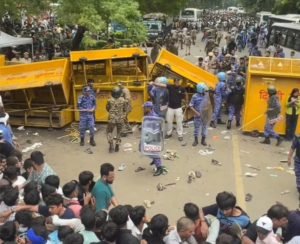
From the early hours, Jantar Mantar transformed into a sea of students, parents, professionals and activists. Many had travelled across India, determined to make their voices heard over allegations of corruption in competitive examinations and to demand the resignation of Union Education Minister Dharmendra Pradhan.
Authorities had already imposed restrictions on marches towards Parliament House, deployed heavy police and Rapid Action Force (RAF) personnel, and sealed off several key routes. Metro train station exits near the protest zone were restricted, yet demonstrators simply disembarked at distant stations and walked kilometres carrying the tricolour and chanting slogans.
The confrontation escalated when protesters pushed towards Parliament House despite repeated warnings. Police moved in with baton charges to disperse the advancing crowd. Within minutes, tear gas shells filled parts of central Delhi with smoke as security forces attempted to push demonstrators back behind multiple barricades. Videos circulating widely on social media appeared to show protesters being struck with lathis while others scrambled to escape the gas. Delhi Police has disputed some allegations regarding the extent of force used, even as multiple news organisations reported the use of batons and tear gas during the operation.
The atmosphere grew even more volatile as sections of the crowd reportedly breached barricades and advanced closer to Parliament. Security personnel responded by tightening the cordon, while detentions were reported from different locations. Protesters insisted they would not retreat despite repeated police action, describing the march as a fight for the future of India’s students rather than merely a political demonstration.
Adding another dramatic twist, CJP founder Abhijeet Dipke was reportedly detained during the unfolding events. At almost the same time, senior CJP representatives confirmed that government had initiated talks and that discussions with Union Minister J.P. Nadda were underway. The extraordinary contrast—a baton charge on the streets while negotiations took place behind closed doors—captured the paradox of the day.
The protests have gathered enormous momentum following the forcible hospitalisation of environmentalist Sonam Wangchuk after his prolonged hunger strike in solidarity with the movement. For many demonstrators, today’s march became as much about defending the democratic right to protest as about demanding reforms in India’s education system.
The events unfolding in Delhi now raise uncomfortable questions for India’s democracy. Was the police response a necessary law-and-order measure to protect Parliament during the Monsoon Session? Or did the images of tear gas and lathis against largely unarmed protesters hand the movement greater moral strength than any speech ever could?
As smoke drifted across the capital and slogans echoed through the streets, one thing became unmistakably clear: the Cockroach Janta Party is no longer an online protest. It has become a national movement that has forced itself into the country’s political conversation.
Whether July 20’s confrontation ends in meaningful reforms, prolonged unrest or a deeper political reckoning will depend on what happens next—not only inside Parliament, but also on the streets just outside its gates.